Brass Helical Knurled Inserts About
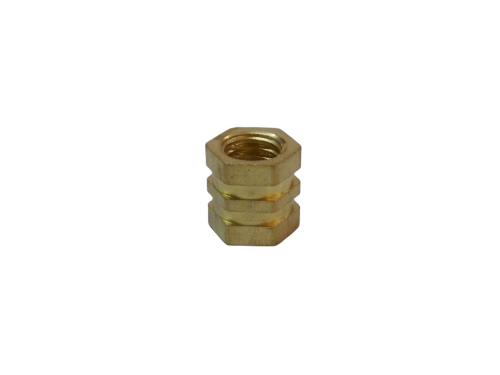
Brass Helical Knurled Inserts
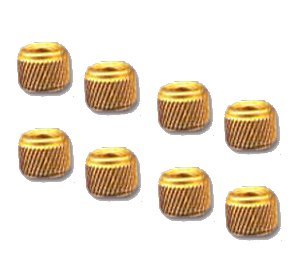
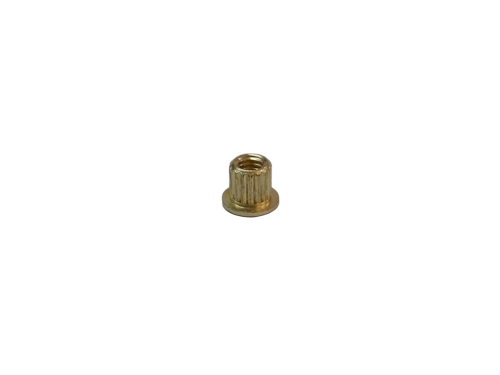
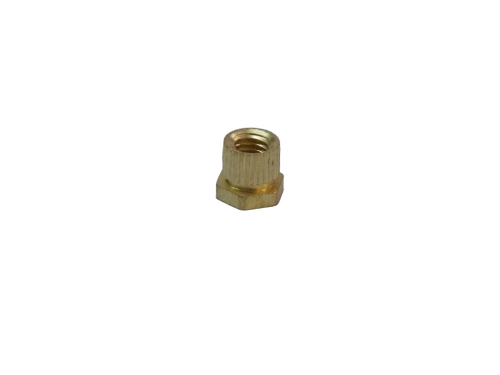
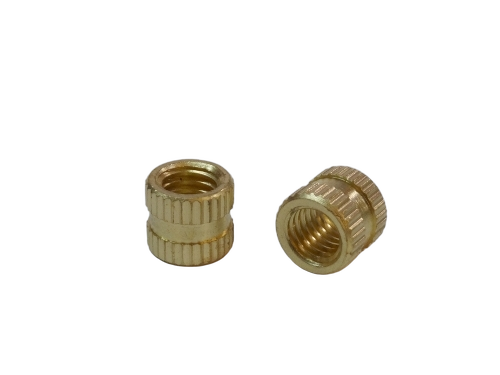
We are manufacturer and exporter of Brass Helical Knurled Inserts. We have wide range available in brass inserts. We can provide in Round Inserts, Hex Inserts, Square Inserts, Knurling Inserts, Threaded Inserts and as per customers requirement.
Material
Free Cutting Brass IS 319 Type (l)
Free Cutting Brass as per BS 249 Type(I)
Generally Free Machine Grade of CuZn37Pb3 equivalent to BS 2874 is used to manufacture various brass threaded inserts in form of round, Hexagon, Square etc
Other grades which are followed as per custom requirements are CZ 121, CZ 131, C3604, CDA 360, and DTD 627 etc
High Grade Free Cutting Brass.
Any Special Brass Material Composition as per customers requirement
Threads
ISO Metric (MM Threads)
BA Threads
BSW Threads (Inches)
UNC, UNF,UNEF and NPT Threads
BSP & BSPT (Parallel & Taper Threads)
Any threads as per specifications
Features
Thread as per international Go and Not Go Gauge Standard.
Deep Groove for maximum Pull out Resistance.
Inner Diameter (ID) after threading with very close tolerance to prevent unrequired flush to enter into brass inserts.
Application
Plastic Industry
Rubber Industry
Electronic Industry
Electrical Industry,etc...
Superior Holding PowerThe helical knurled surface on these brass inserts ensures exceptional grip within plastic and thermoplastic assemblies. This design maximizes torque resistance, preventing rotation or pull-out even under high-load conditions. The combination of high-grade brass material and precision knurling delivers optimal strength and reliability for long-lasting performance.
Wide Customization OptionsThese inserts can be tailored for diverse projects, with customization available for size, length (3 mm30 mm), diameter (3 mm20 mm), thread type (Metric, UNC, UNF, BSW), and surface finish (polished or plated). Inner thread sizes from M2 to M12, or other specifications, ensure compatibility with most fastening systems. Custom capacities and finishes make them suitable for various industrial requirements.
High Temperature and Corrosion ResistanceManufactured with premium brass alloys and polished/plated finishes, these inserts are designed to resist corrosion and withstand temperatures up to 300C. They offer stable performance in challenging environments, making them ideal for automotive, electrical, and demanding industrial settings requiring durability and longevity.
FAQs of Brass Helical Knurled Inserts:
Q: How are Brass Helical Knurled Inserts installed into plastic or thermoplastic materials?
A: Brass Helical Knurled Inserts are typically installed using press-fit or ultrasonic insertion methods. The helical knurling allows the insert to grip securely within pre-formed holes, providing high torque resistance and preventing rotation or pull-out under load.
Q: What customization options are available for these inserts?
A: These inserts can be customized in terms of length (3 mm to 30 mm), diameter (3 mm to 20 mm), internal thread size (M2 to M12 or as specified), knurl pattern, and surface finish (polished or plated). Thread types such as Metric, UNC, UNF, and BSW are also supported as per customer requirements.
Q: Where are these brass inserts commonly used?
A: Brass Helical Knurled Inserts are widely used in plastic moulding, thermoplastics, electrical appliances, automobile assemblies, and other demanding engineering applications that require secure fastening solutions and high mechanical strength.
Q: What process ensures the high grip strength and precise threads of these inserts?
A: A precision machining process combined with helical knurling and advanced quality control methods produce high grip strength, accurate thread profiles, and uniform tolerances (0.05 mm), ensuring optimal fit and performance.
Q: What are the main benefits of using brass helical knurled inserts?
A: Key benefits include easy installation, high torque and load resistance, corrosion protection, RoHS compliance, and the ability to withstand temperatures up to 300C. The inserts ensure stable, long-term fastening in a variety of industrial environments.
Q: When should a customer consider using custom inserts instead of standard options?
A: Custom inserts are ideal when standard sizes or thread types do not meet specific application needs, such as unique material thickness, different mechanical requirements, or special surface finishes. The manufacturer can accommodate custom capacities and designs based on detailed customer drawings.






 Send Inquiry

 Send Inquiry
 Send Inquiry
 Send SMS